
BY Led Black (@Led_Black)
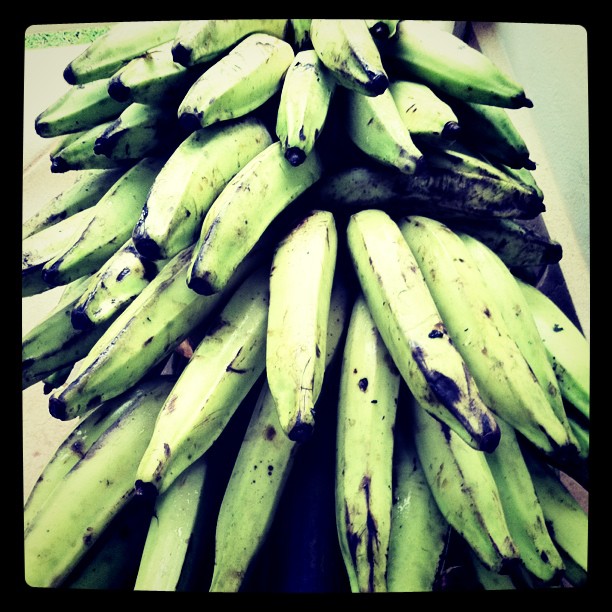
This is a poem I conceived while I was at a resort in the Dominican Republic feverishly fiending for some Dominican food. It is only so much “international food” one can eat, especially when you are on Dominican soil.
It is a bit over the top with Shakespearian overtones but that is how I felt at the time. It is an excerpt from my forthcoming book, DR Travelogue.
I Love Platanos – An Ode to Platanos
Oh Platano, how we Dominicans love you
You are forever welcome at every Dominican table whether it is breakfast, lunch or dinner, entrée or dessert
You delight in all your incarnations; maduros, tostones, asado, mangu or mofongo
Can’t forget the pastellon or the platano con azucar or any of your many variations
I even had a fresh off the boat cousin who made Platano juice,
Umm umm umm, Delicioso
Your versatility never ceases to amaze
Oh Platano, how we Dominicans love you
You are the constant companion, the faithful friend of all Dominicans
Without you, rice, beans & meat is just rice, beans & meat
Who would eat Salchichon without your accompaniment?
You are the muse of all Dominicans mothers
Oh Platano, how we Dominicans love you
Woe be to those who refer to you as green Bananas
That borders on being racist
Bananas are bananas and platanos are platanos
I’m also not too fond of the term Plantain
Words tend to lose meaning when they become anglicized
Long Live Platanos!!!
Related:
Led Black: Un Pie Aqui y Uno Alla | Huffington Post
We invite you to subscribe to the weekly Uptown Love newsletter, like our Facebook page and follow us on Twitter & Instagram or e-mail us at [email protected].


JS
September 16, 2011 at 12:00 pmUh I know that is a poem and all but “platanos” are indigenous to Southeast Asia where they speak Tagalog and Malay, and “plantain” has been in use since at least 1555.
uptownco
September 16, 2011 at 12:28 pmHey Js – thank for the correction and comment. I wonder what the word for mangu in Tagalog and Malay is. Do you know professor? Please enlighten us.
Platano1234
February 20, 2014 at 11:40 amSTFU you stupid mamhuevo. Don’t disrespect Los plata noes coño!! Rees in hombre que no sabe nada!
haha
May 18, 2015 at 8:34 pmhahahaha
JS
September 17, 2011 at 6:35 pmMangu is a traditional Dominican dish so there probably isn’t a Tagalog or Malay word for it, in which case they would say “mangu.”
The point of my previous comment was not to diminish the the special place that platanos have in Dominican cooking and culture. It was to point out how the author, in putting down the term “plantain,” ignored hundreds of years of history to do so.
Clyde Tressler
September 20, 2011 at 11:58 amJS-
I thought your comment was relevant and interesting. I didn’t know that bit of history and I’m sure many people don’t.
Also, I have heard Jamaicans call platanos ‘green bananas,’ but i don’t think it ‘borders on being racist.’ I think that’s just what they call them.
To the author: don’t be insulted that people want to engage with your work. That’s not such a bad thing. It’s worse when no one has a peep to say about it, I think.
uptownco
September 20, 2011 at 12:20 pmHey Clyde – thanks for the comment. I wasn’t insulted that people wanted to engage with the work, I really appreciate that. My problem is with the tone that JS employed. He provided some useful info and I thanked him for that.
Also, the piece was a poem that I myself stated was over the top. It was an honest reflection of how I felt at a particular time during my trip to the Dominican Republic. Thanks again Clyde for your comment and feedback.
Led
clyde tressler
September 20, 2011 at 12:28 pmtone is a tricky thing to decipher, i guess i heard him a little differently. i probably would have stopped short of calling him ‘professor,’ but maybe i mistook the tone of that comment too 😉
thanks led!
uptownco
September 20, 2011 at 12:33 pmYou know what Clyde, I think you are right. I regretted my tone afterwards as well. I said it in jest but it could have been misconstrued. Thanks for the dialogue.
Led
clyde tressler
September 20, 2011 at 12:34 pmno problem!